

About TOKUSEN KOGYO
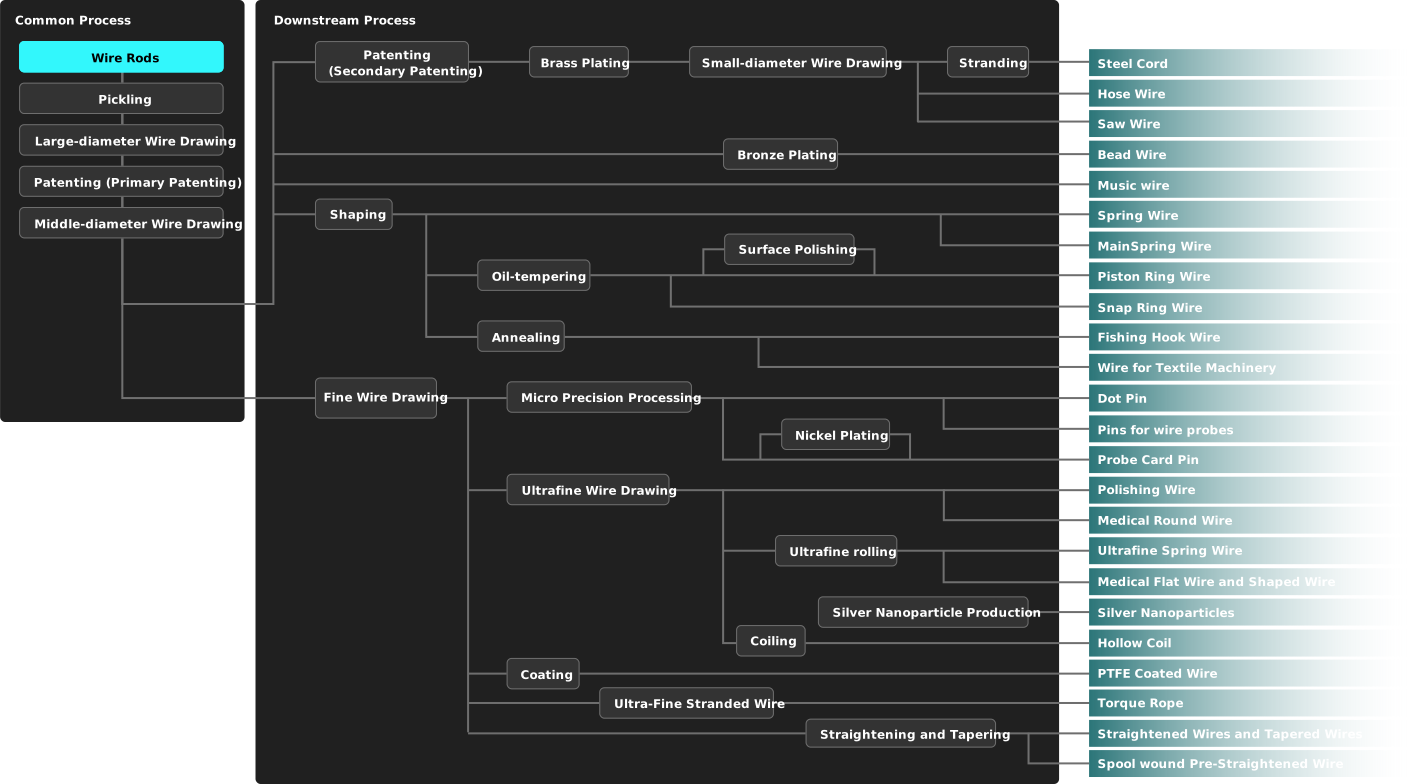
Product Manufacturing Processes Connected by Technologies
Wire drawing, shaping, stranding, heat treatment, surface treatment, and special processing.
Our strength is our ability to handle all of these core processes in-house, from start to finish.
By combining a wide range of technologies, we create the optimal form for each product.
On this page, we introduce the manufacturing processes behind our products, along with the products themselves.
-
Explore by Manufacturing Process
- Explore by Product
- Explore by Technology

View
Manufacturing
Processes
SCROLL
STEP
01
Wire Rods
Receive 1–2 ton coil-form raw materials from wire rod manufacturers, specified to meet the required standards for final products and their quality requirements.
※Raw materials and processes may vary depending on specifications.
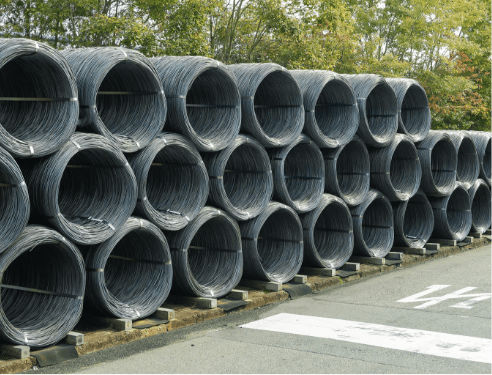
This is where it all begins.
Process this wire rod into products for a wide range of applications using our diverse technologies.
STEP
02
Pickling
Remove scale (iron oxide) from the wire rod surface and apply a coating required for the next process, the dry wire drawing process.
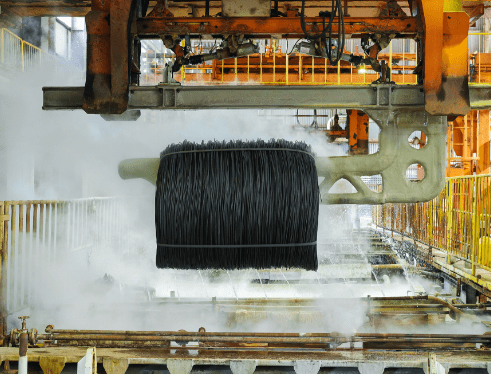
Technique used in Pickling
- Surface treatment
Remove scale (iron oxide) adhering to the wire rod surface through acid pickling. Then, form a phosphate coating (bonderizing treatment) on the surface to ensure smooth subsequent wire drawing.
STEP
03
Large-diameter Wire Drawing
Using dies, the wire is reduced in diameter from φ5.5 mm to approximately φ3.0 mm.
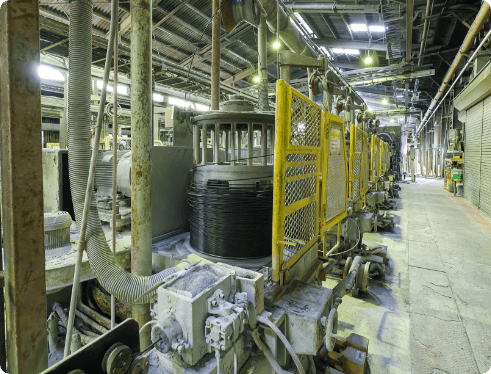
Technique used in Large-diameter Wire Drawing
- Wire drawing
A cold drawing process in which a wire rod is drawn through dies using a dry lubricant, reducing its cross-sectional area while increasing its length. After lubrication for wire drawing during pickling, he wire rod is sequentially passed through multiple dies, gradually reducing its diameter and achieving high dimensional accuracy.
STEP
04
Patenting (Primary Patenting)
This process restores the toughness of the wire rod after large-dimenter wire drawing and refines its microstructure for subsequent wire drawing.
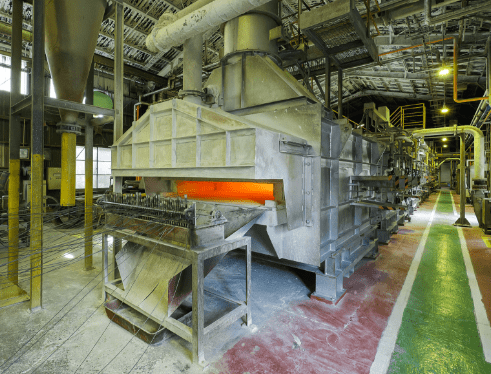
Technique used in Patenting (Primary Patenting)
- Heat treatment
An important process that removes work-hardening strain and restores ductility and toughness of the wire rod. After wire drawing, recrystallization is promoted to prevent factors that may hinder subsequent processes, such as cracks and abnormal microstructures. High-carbon steel wires are quenched and tempered to impart strength and elasticity, forming a uniform pearlite structure.
STEP
05
Middle-diameter Wire Drawing
Using dies, the wire is reduced in diameter from φ3.0 mm to approximately φ1.0 mm.
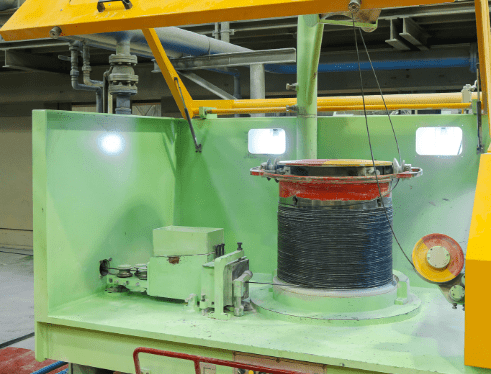
Technique used in Middle-diameter Wire Drawing
- Wire drawing
A cold drawing process in which a wire rod is drawn through dies using a dry lubricant, reducing its cross-sectional area while increasing its length. After being lubricated for wire drawing during the patenting process (first heat treatment), he wire rod is sequentially passed through multiple dies, gradually reducing its diameter and achieving high dimensional accuracy.
NEXT
Go to Process
- Patenting
(Secondary Patenting) - Bronze Plating
- Shaping
- Fine Wire Drawing
Go to Products
- Music wire